
The shift from points to tokens
The traditional loyalty model relies on static points locked within a single brand’s ecosystem. These points function as closed-loop credits with limited utility and no secondary market. The emerging standard replaces these siloed assets with fungible blockchain tokens. This transition shifts loyalty rewards from internal accounting entries to portable digital assets that retain value across platforms.
Tokenized rewards allow brands to upgrade their loyalty programs by offering interoperable assets. Academic research indicates that this fungibility increases booking intentions for hospitality brands and drives higher engagement across sectors. By treating points like shares of stock, companies enable users to trade, hold, or transfer rewards, fundamentally changing the incentive structure.
This architectural change demands rigorous technical robustness. Unlike traditional databases, tokenized systems require smart contract auditing and compliance with financial regulations. The shift is not merely cosmetic; it requires a secure infrastructure that supports real-time settlement and transparent ownership records.
For market participants, this transition represents a move toward open-loop loyalty networks. Brands that fail to adopt this infrastructure risk losing relevance as consumers increasingly prefer rewards they can actually use. The technology is mature, but the regulatory landscape remains complex, requiring careful navigation by early adopters.
How smart contracts replace legacy databases
Traditional loyalty programs rely on centralized, siloed databases. Each brand maintains its own ledger, isolating points and preventing them from moving outside that specific ecosystem. Tokenization changes this by migrating points onto a blockchain. In this architecture, smart contracts replace manual database entries, automating issuance, redemption, and transfer rules with code that executes exactly as written.
This shift transforms points from internal ledger entries into on-chain digital assets. Unlike legacy points, which are liabilities bound to a single company’s books, tokens are standardized units of value. This standardization enables interoperability. A customer can hold tokens from multiple brands in a single digital wallet, trading or combining them without needing separate accounts or complex API integrations between competing platforms.
The technical mechanism relies on token standards like ERC-20 for fungible points or ERC-721 for tiered memberships. These standards ensure that the tokens are compatible across different exchanges, wallets, and partner networks. Smart contracts handle the logic: they verify eligibility, deduct balances, and update the global state transparently. This reduces the operational overhead of reconciliation and eliminates the friction of manual point transfers.
From a compliance and security perspective, this architecture offers significant advantages. Blockchain’s immutable audit trail provides a clear, tamper-resistant record of every transaction. This transparency simplifies regulatory reporting and reduces the risk of fraud or data manipulation. Smart contracts enforce rules automatically, minimizing human error and ensuring that loyalty liabilities are managed with greater precision and accountability.
Engagement mechanics and tradability
Tokenized loyalty programs shift the value proposition from static accumulation to active utility. Unlike traditional points that sit idle in siloed accounts, tokenized rewards introduce fungibility and interoperability. This structural change fundamentally alters user behavior by allowing customers to trade points with others or convert them into cash or other assets, as noted in recent academic research on the role of tradability in loyalty ecosystems [1].
The introduction of tradability directly impacts booking intentions. Research indicates that when customers perceive their rewards as liquid assets rather than locked-in credits, their engagement with the brand increases significantly [2]. This is not merely a psychological effect; it is a mechanical advantage. When points can be exchanged or transferred, the perceived value of the loyalty program rises, making it a more competitive tool for customer acquisition and retention.
To understand the operational difference, consider the contrast between legacy systems and tokenized frameworks:
The data above highlights a critical shift: tokenized rewards are not just a digital version of old points. They are a new asset class within the loyalty ecosystem. This interoperability allows brands to partner with other platforms, expanding the utility of the reward beyond the original service. For the customer, this means greater control and flexibility, which translates to higher lifetime value for the brand.
From a compliance and technical robustness standpoint, this shift requires rigorous infrastructure. The ability to trade and transfer rewards introduces new regulatory considerations, including anti-money laundering (AML) checks and secure identity verification. Brands must ensure that their tokenization platforms are built with these constraints in mind from the ground up, rather than as an afterthought. The technical complexity is higher, but the potential for increased engagement and revenue is proportionally greater.
[1] Hu, J. (2025). Tokenizing Loyalty Programs: The Role of Tradability. SSRN. [2] Boukis, A. (2024). The effect of tokenized rewards on customer loyalty programs. ScienceDirect.
Implementation risks and downsides
Tokenized loyalty programs introduce significant operational friction that traditional database systems do not possess. The transition from centralized ledgers to distributed blockchain architectures requires rigorous technical planning. Brands must navigate complex regulatory landscapes, volatile transaction costs, and steep user adoption barriers.
Regulatory Compliance
The primary risk lies in the legal classification of loyalty tokens. Regulators increasingly scrutinize tokenized rewards that exhibit fungibility, as they may be classified as securities rather than simple utility points. This classification triggers strict compliance requirements, including anti-money laundering (AML) checks and know-your-customer (KYC) protocols. Failure to structure the token correctly can result in severe penalties or the forced shutdown of the program.
Gas Fees and Transaction Costs
Blockchain transactions require gas fees, which are paid in the network’s native cryptocurrency. These fees fluctuate based on network congestion and can render micro-rewards economically unviable. For example, a gas fee of $2 to redeem a $0.50 discount destroys the value proposition for the customer. Brands often absorb these costs, which erodes margins, or they must implement layer-2 scaling solutions to keep transactions affordable.
User Experience Friction
The most immediate hurdle is the user experience. Traditional loyalty programs operate silently in the background; tokenized programs require users to manage digital wallets, private keys, and transaction approvals. This added complexity creates a high barrier to entry. If the onboarding process is not seamless, customer drop-off rates will spike, negating the potential benefits of increased engagement and data transparency.
Choosing a tokenization platform
Selecting the right infrastructure requires balancing immediate technical capabilities with long-term ecosystem viability. The decision framework below outlines the critical evaluation steps for enterprises deploying tokenized loyalty points.
Assess the platform’s ability to integrate with existing customer relationship management (CRM) and enterprise resource planning (ERP) systems. Robust, documented APIs are essential for syncing real-time token balances with legacy backend databases. Without seamless integration, tokenized rewards remain siloed and fail to drive measurable engagement across your current digital touchpoints.
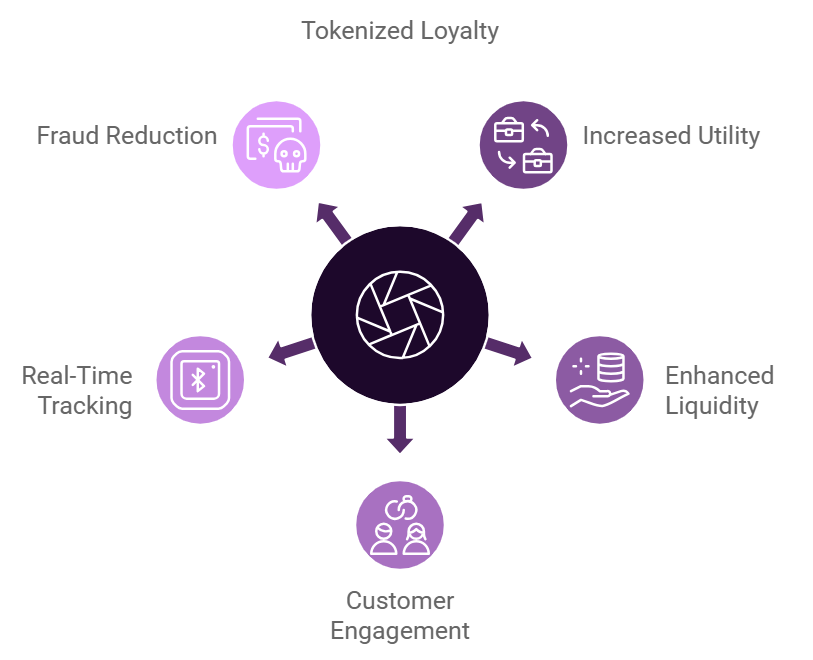
Tokenized assets carry regulatory weight. Prioritize providers with audited smart contracts and clear compliance frameworks for KYC (Know Your Customer) and AML (Anti-Money Laundering) protocols. Verify that the platform supports tiered access controls and transaction limits to mitigate fraud and ensure adherence to financial regulations in your operating jurisdictions.
The friction of wallet creation is the primary barrier to entry. Analyze the platform’s guest wallet features and social login integrations. A successful tokenization strategy abstracts blockchain complexity from the end-user, allowing customers to redeem points without managing private keys or seed phrases. Smooth onboarding directly correlates with token adoption rates.
Determine if the platform supports multi-chain compatibility or specific token standards (e.g., ERC-20, ERC-1155). Interoperability allows your loyalty tokens to be traded, gifted, or redeemed across partner networks. Platforms that restrict tokens to a closed loop limit the perceived value of the asset and reduce its utility as a flexible currency.

High-stakes deployments require guaranteed uptime and rapid incident response. Review the provider’s service level agreements (SLAs) for transaction processing speeds and dispute resolution. Technical robustness is not just about code; it is about the operational support structure that ensures your loyalty program remains available during peak redemption periods.
Common questions about token rewards
Tokenized loyalty programs offer fungibility and interoperability, but they introduce technical and regulatory complexities that traditional points systems do not. Understanding the downsides and selecting the right infrastructure is critical for compliance and operational stability.
What is the downside of tokenization?
The primary downsides of tokenizing loyalty points are regulatory uncertainty and technical complexity. Unlike closed-loop points, fungible tokens may be classified as securities or money transmission instruments, requiring strict adherence to financial regulations. Additionally, implementing smart contracts demands significant development resources and ongoing security audits to prevent exploits.
What are the best tokenization platforms?
Selecting a platform requires evaluating security, scalability, and compliance features. Established providers like Enable3 and Photon offer specialized infrastructure for converting loyalty points into tokens. These platforms typically provide SDKs for integration, ensuring that the underlying blockchain operations remain secure and compliant with evolving standards.
No comments yet. Be the first to share your thoughts!